|
|
Original evidence
The theory so far
Notes
End notes
|
Disproved theory
|
Theory of our descent from Blennerhassett
There has been one
epic problem in all my family tree research:
The Blennerhassett problem.
This is the problem of how we descend from the Blennerhassett family.
I first became aware of our possible descent from Blennerhassett in 1985.
Pretty soon it was clear that our origin must be through
some irregular child or runaway marriage.
But who? And could I prove it?
Little progress was made until 2020, when
DNA proved we definitely descend from the
Blennerhassett Baronets branch.
We found many strong DNA matches with the family of the 1st Baronet and, crucially, the family of his wife and mother.
Since 2025, we have made progress on two further fronts, the
O'Connell family
and the
Stephen Cashel family.
We now have a mountain of clues and hints, but still not the final answer.
It seems that we are very close to putting together these three pieces.
This page lays out what we know so far.
Let us start with the first evidence at the start of this hunt.
The first evidence of our family's descent from Blennerhassett
is the use of
"Blennerhassett" as a first name and middle name in our family.
I grew up with the name "Blennerhassett" in the family.
For example, talking to my grandmother in the 1980s
about her grandfather
Blennerhassett Cashel (died 1915).
Everybody knew the name. It was impossible to avoid.
The people in our family with "Blennerhassett" as a name are:
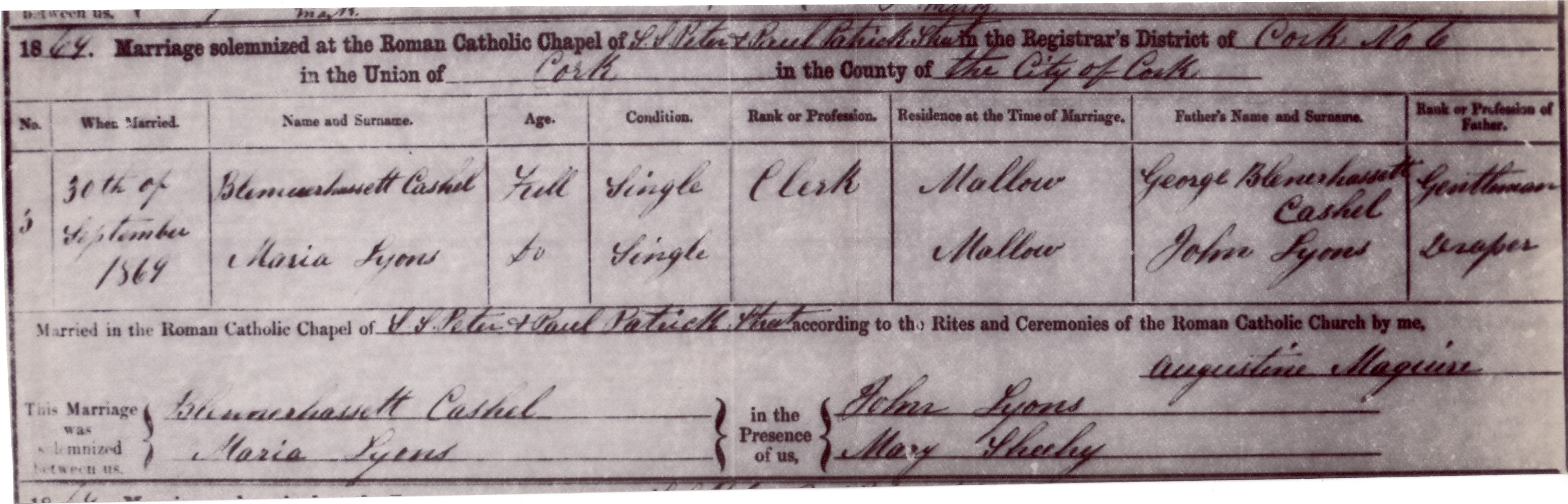
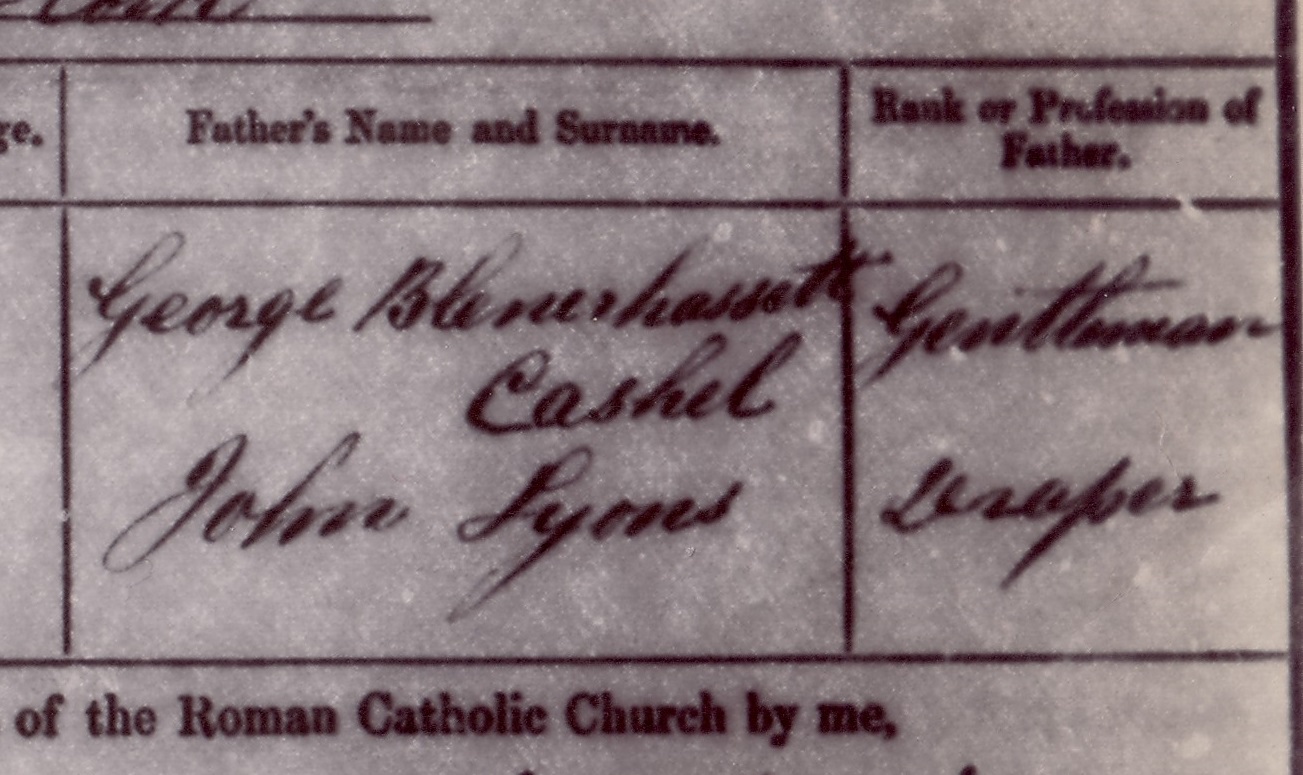 George Cashel
 is written
"George Blennerhassett Cashel"
on the marriage cert of his son
Blennerhassett Cashel in 1869.
See
full size.

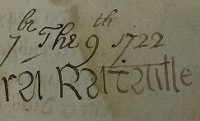
Baptism of George's son Blennerhassett Cashel, 18 June 1848.
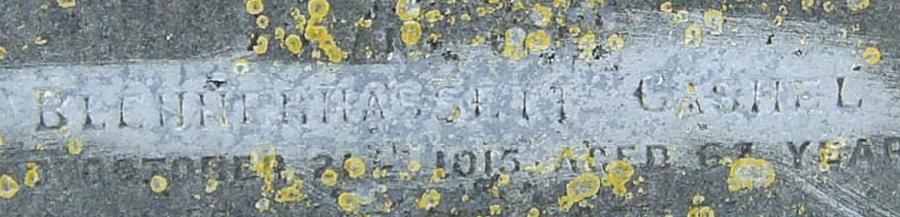
Detail from grave of
Blennerhassett Cashel.
As well as using the name "Blennerhassett",
our family had preserved a family story.
Actually the story was lost to living tradition,
but was found in
the
Papers of Patricia Lavelle.
Pat Lavelle died in 1966.
But her family history notes survived, and I read them in the 1980s.
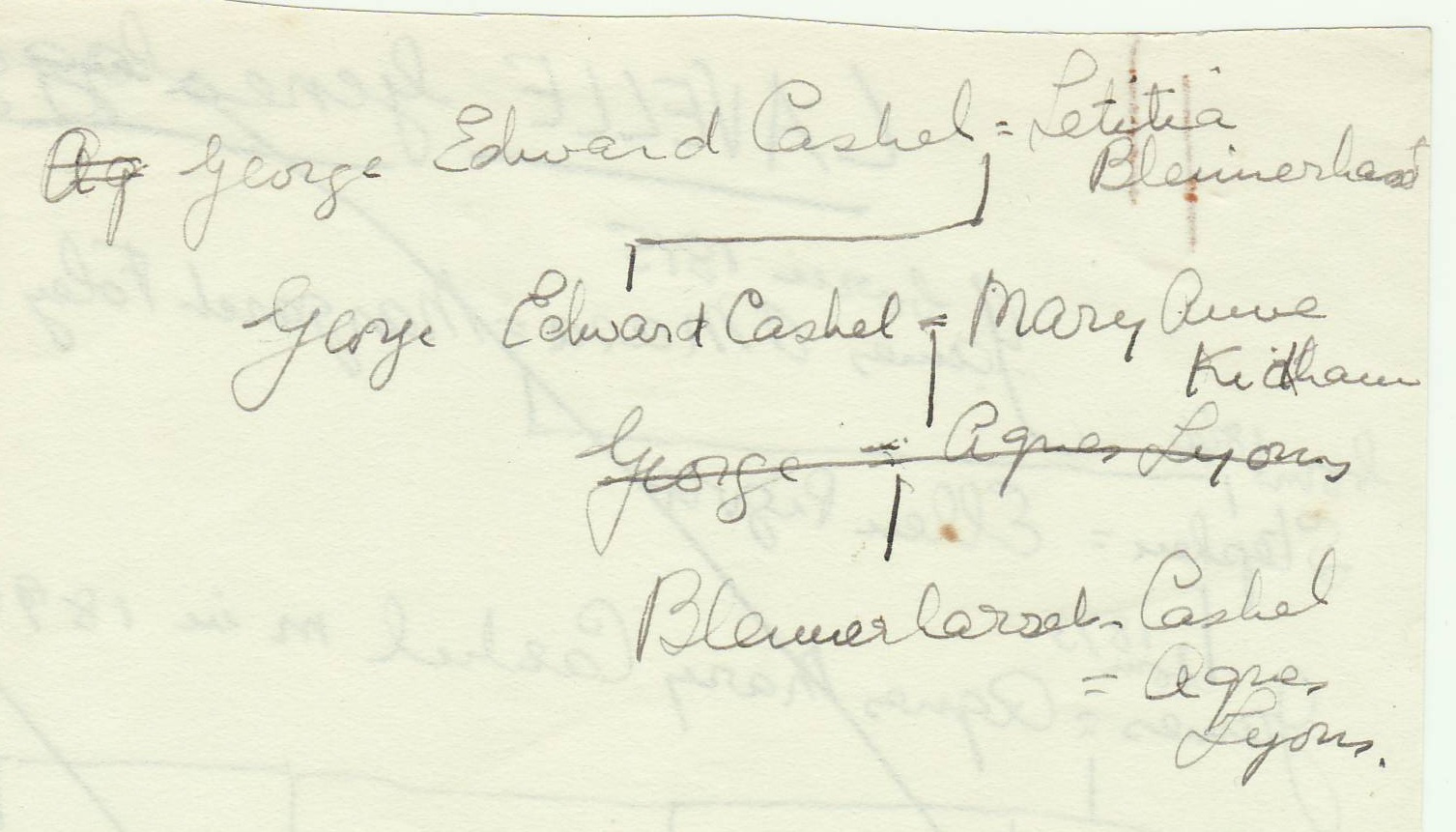
Pat Lavelle's notes say
we descend from a runaway Blennerhassett marriage.
She said it was the mother of
George Cashel
who was a Blennerhassett,
and her name was "Letitia Blennerhassett".
The story is that
the Protestant Letitia Blennerhassett
had a romantic runaway marriage with the Catholic
Edward (or George) Cashel
and they were the parents of George Cashel, father of Blennerhassett Cashel.
The story was that the Blennerhassett girl was disinherited for running away with a Catholic.
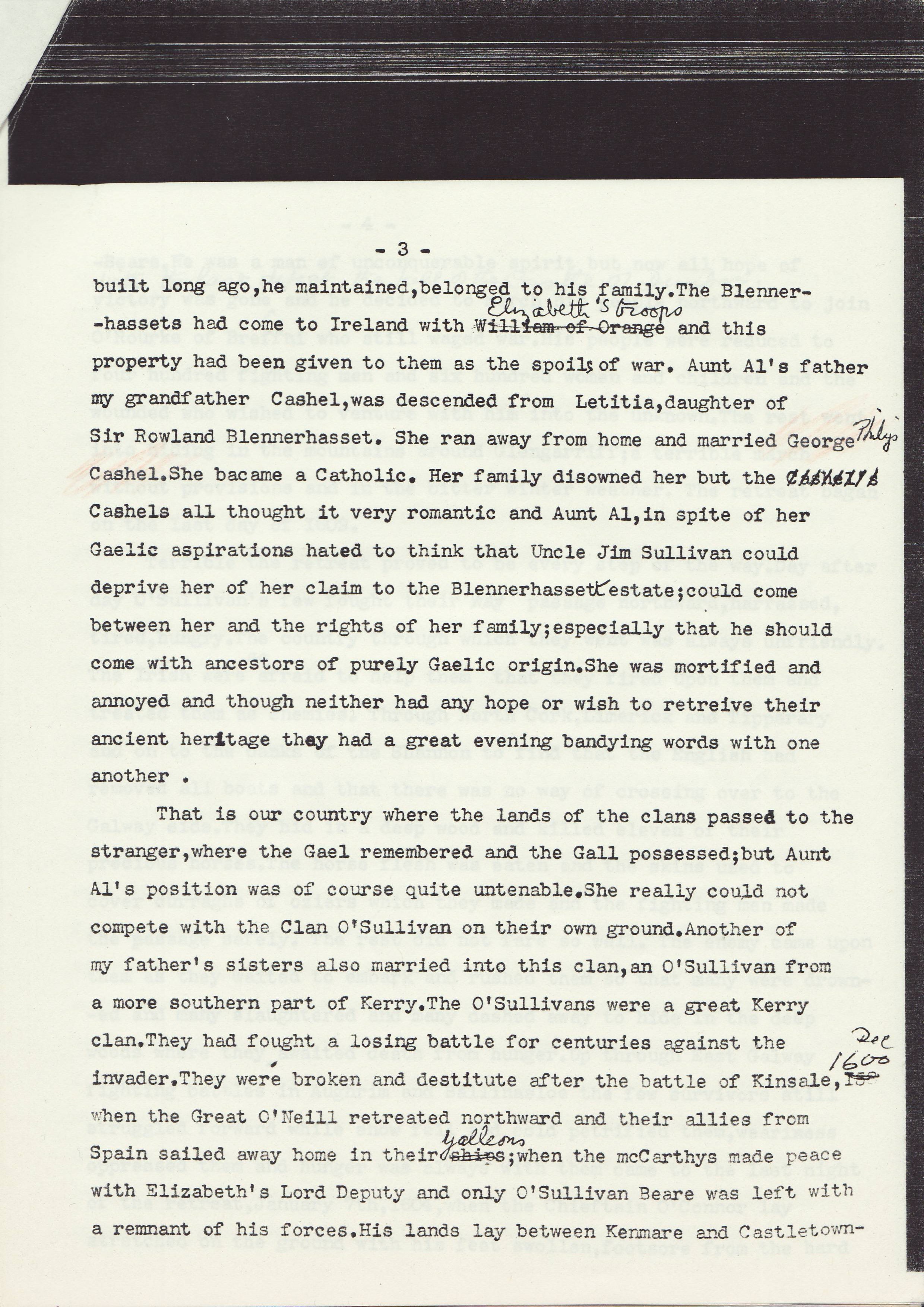
[PAT/10, p.3]
said:
"Her family disowned her but the Cashels all thought it very romantic".
Pat probably got this information from
her mother
Agnes Cashel (died June 1958)
or her aunt
Alice Cashel (died Feb 1958).
Alice Cashel certainly knew about the Blennerhassett connection.
See argument between Alice Cashel and Jim Sullivan.
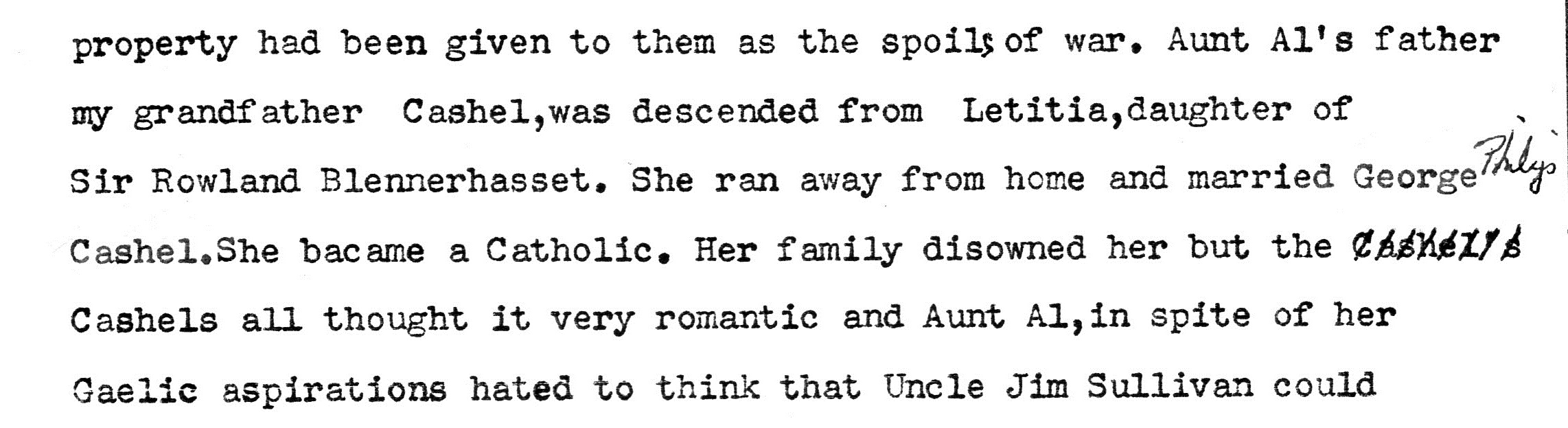
The story in my family of a romantic runaway Blennerhassett marriage.
In the notes of my grandaunt
Pat Lavelle.
From
[PAT/10, p.3].
See
full size.
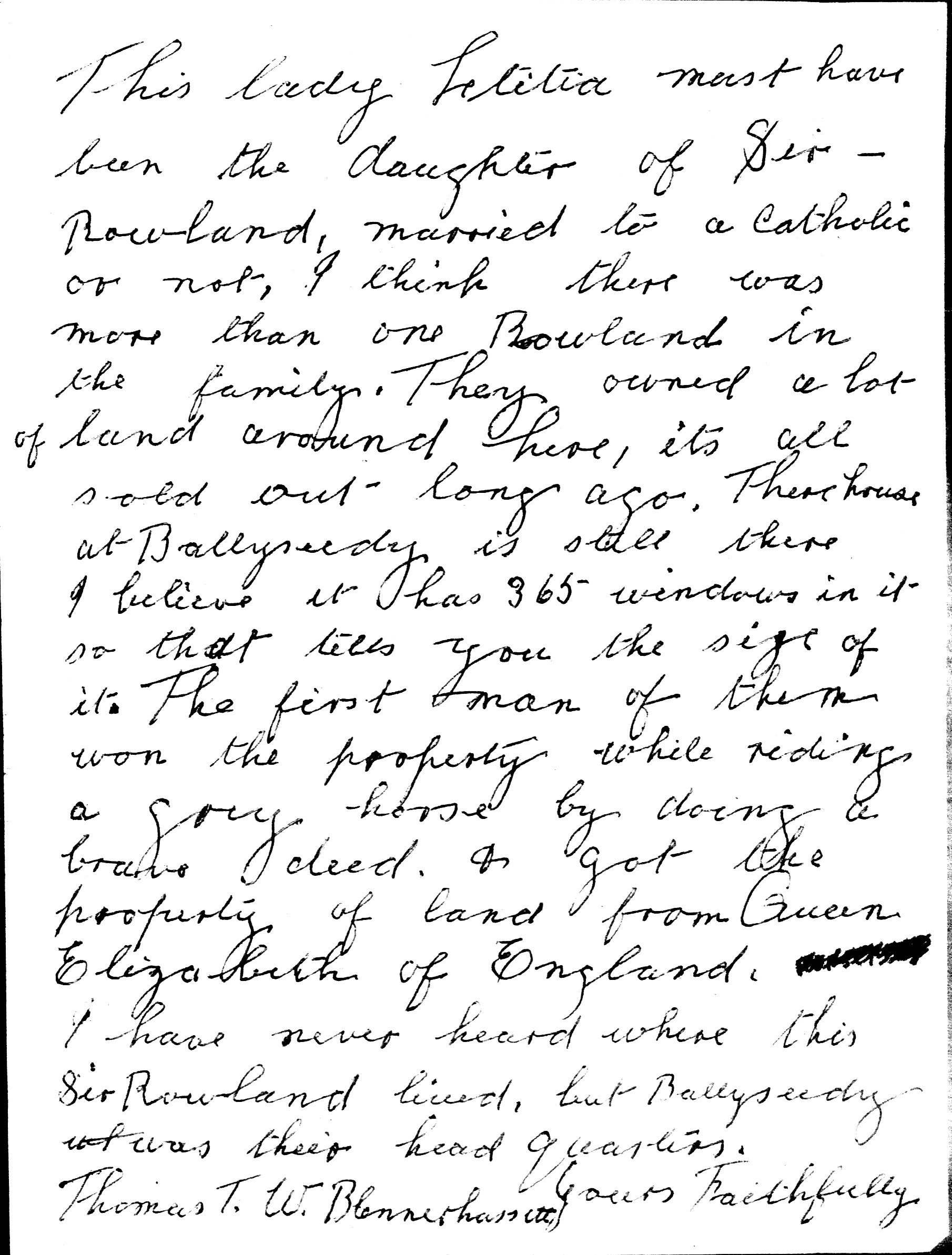
- The notes above include "Sir Rowland Blennerhasset" as a named parent for Letitia.
It is unclear if this named parent for Letitia
is part of the original family story
or a later addition, included only after the
Gortatlea letter in 1965,
or some combination of both.
More on this below.
We will also discuss below whether this named parent is correct.
- There is an illegible word written here beside "George Cashel",
looks like "Philip"
(see the dot for the second "i").
Does this mean "George Philip Cashel"?
So far, this lead has led nowhere.
The unusual name "Letitia Blennerhassett"
seems like a strong clue.
How would such a rare name be remembered as George Cashel's mother?
The following are the only known Letitia Blennerhassetts of child-bearing age in the world
in 1807.
Both of them are married at the time, and not to Cashel.
- Letitia Blennerhassett of Tralee and Tarbert, Co.Kerry, born 1780.
She
married 1stly, 1799,
to Richard Ponsonby and had issue.
She
married 2ndly, 1811, to William Lindsay and had issue.
There was some pretty good paper evidence that it could be her.
- Letitia Blennerhassett of Co.Limerick, born est c.1785.
She
married 1807
to Samuel Harding
and had issue.
There is no particular evidence that it could be her.
I spent many years looking at Letitia Blennerhassett of Tarbert.
There was (and still is) a lot of evidence that made it look like her.
See:
Theory of our descent from Letitia Blennerhassett of Tarbert.
But a detailed DNA study proved it is
not her.
See later.
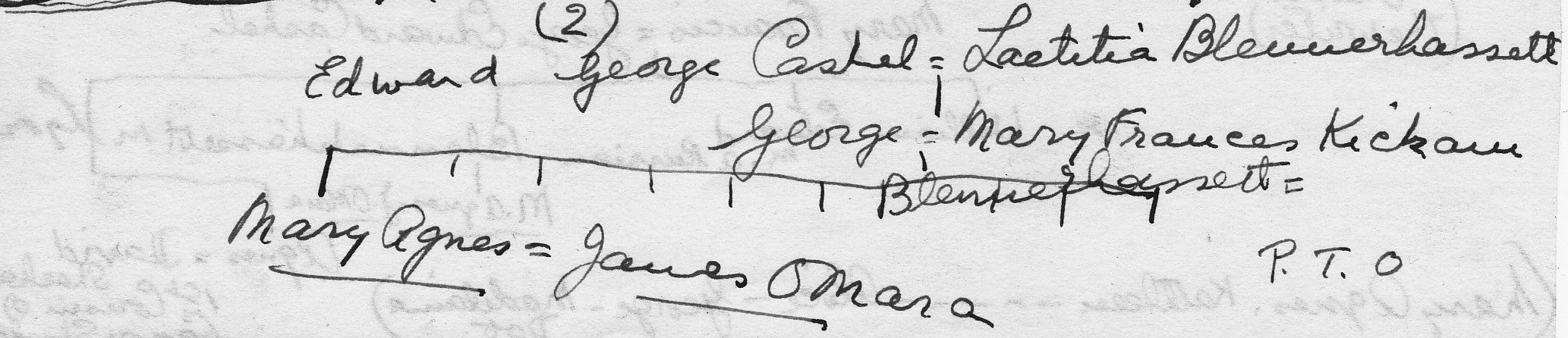
From
[PAT/7, no.3]
and
[PAT/13, no.3].

From
[PAT/13, no.2].
From
[PAT/13, no.6].
Copy in
[PAT/7, no.7].
There is more evidence in the official records.
When
George Cashel
joined the County Constabulary in Sept 1828,
he was recommended by
"A. Blennerhasset, J.P.".
This presumably must be a relation.
One would imagine this would narrow it down.
However, there were multiple prominent and respectable A. Blennerhassett's,
even restricted to that time.
There are basically three candidates for this person, as follows.
In the Ballyseedy branch:
-
Arthur Blennerhassett, of Ballyseedy, Tralee.
High Sheriff of Co.Kerry 1821-22.
In 1834 he is on a Grand Jury.
In 1835 he is one of the Deputy Lieutenants of Co.Kerry, and one of the Magistrates of Co.Kerry.
Died 1843.
In the Baronet branch:
-
Arthur Blennerhassett, of Blennerville, Tralee.
His wife was 1st cousin of the mother of Letitia Blennerhassett of Tarbert.
Appointed J.P. in 1822.
In 1834 he is on a Grand Jury.
Died (still a J.P.) in 1839.
-
Sir Arthur Blennerhassett, 3rd Baronet,
of Churchtown, Killarney.
Nephew of Arthur Blennerhassett, of Blennerville.
High Sheriff of Co.Kerry 1820-21.
He married a Catholic in 1826 and converted to Catholicism in 1827.
So might have been sympathetic to Cashel's position
even if not close relative.
Became 3rd Baronet in 1831.
In 1832 he is one of the Magistrates of Co.Kerry.
Listed as J.P. in 1844.
Died 1849.
Since
two of the three possible Arthur Blennerhassetts are in the Baronet branch,
this indicated our descent might be from the Baronet branch.
This turned out to be true.
See later.
However it is still possible that the Ballyseedy man is the one who wrote the letter of recommendation.

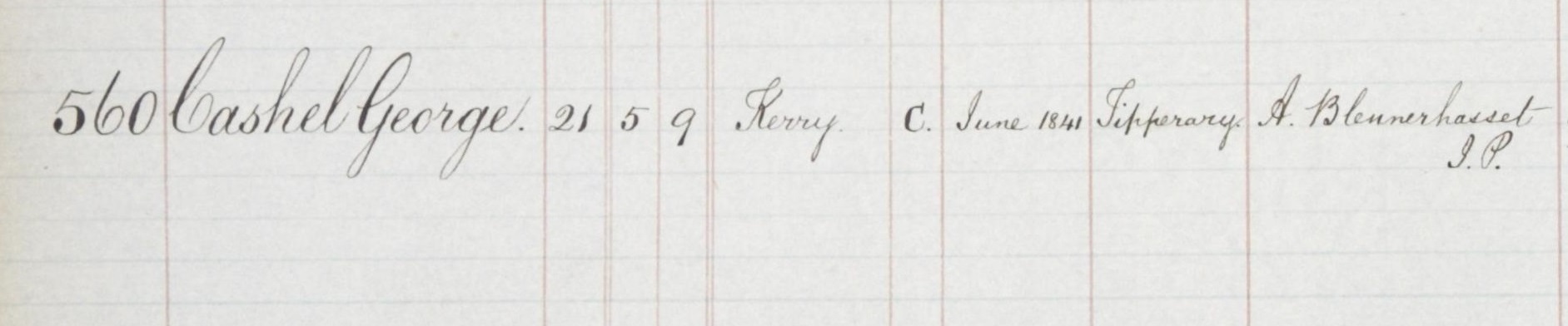
George Cashel's RIC record.
Showing that he was recommended by "A. Blennerhasset, J.P."
when he joined the County Constabulary in 1828.
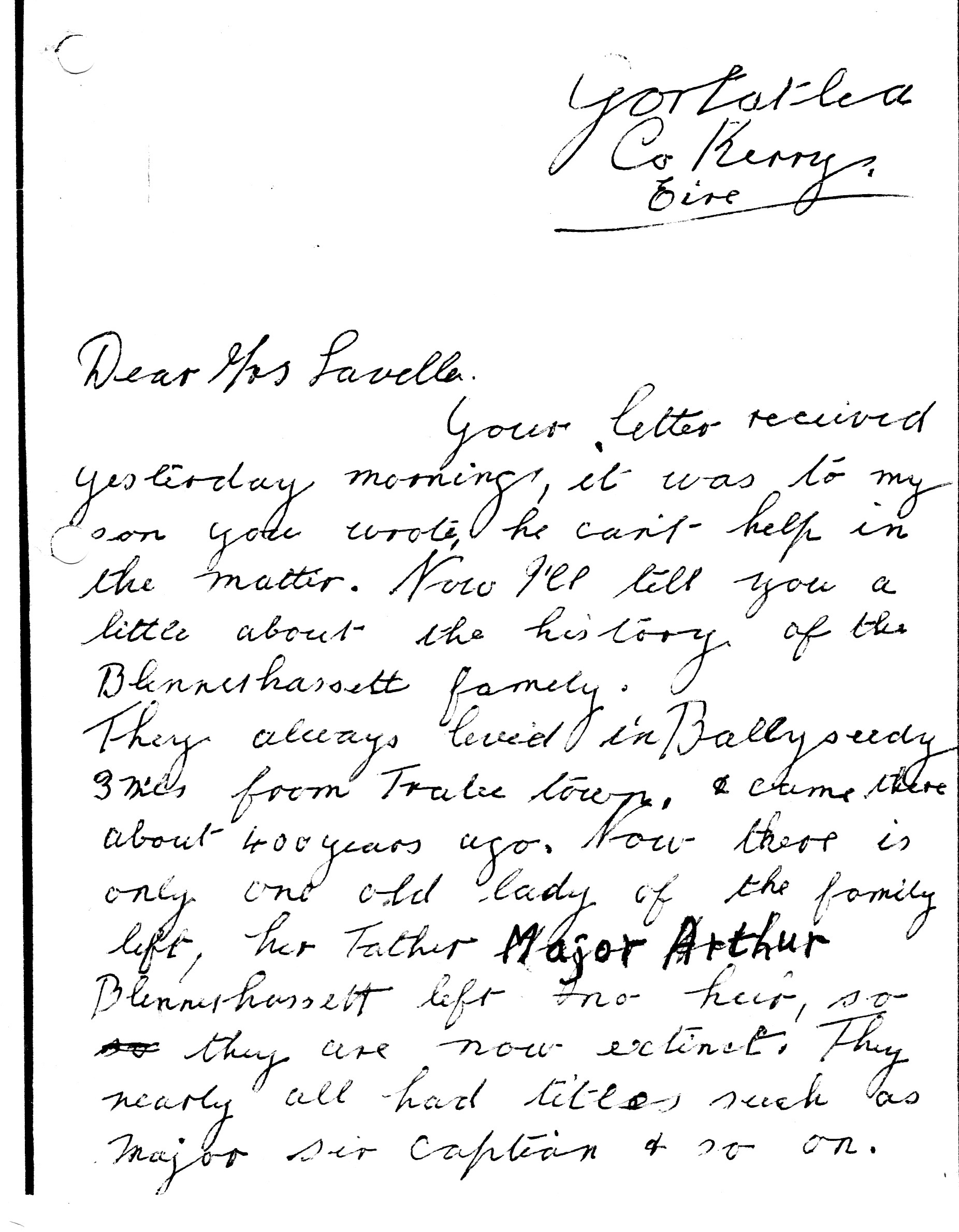
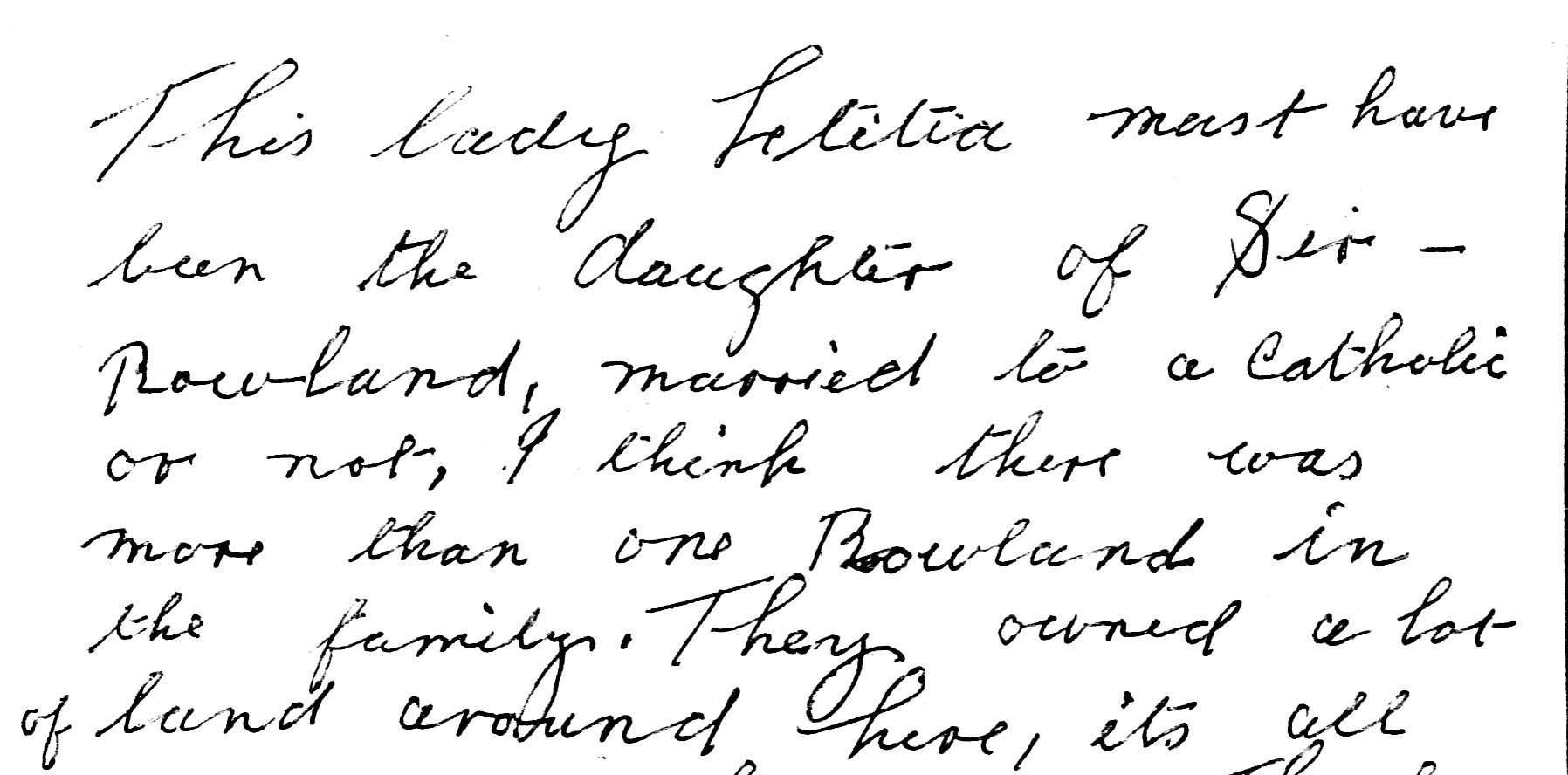 Thomas Blennerhassett of Gortatlea
wrote this letter to
Pat Lavelle
in 1965.
He says Letitia Blennerhassett "must have been"
the daughter of
Sir Rowland Blennerhassett, 1st Baronet.
From
[PAT/14].
See
p.1
and
p.2.
This letter looked unconvincing
So back in the 1980s, I discovered this letter telling me
Sir Rowland Blennerhassett, 1st Baronet
was father of Letitia.
Why did I not believe it?
Basically, this letter was not very convincing:
-
Thomas Blennerhassett
does not provide any evidence for his statement.
- According to the official histories like Burke's Peerage, the 1st Baronet had no daughter.
-
It is clear from the wider letter
that he knows little about the family history.
For example, he only "thinks" there are other Rowlands.
But anyone who knows anything about the Blennerhassett family would know all about
Rowland the famous Home Rule MP
and
Sir Rowland the famous writer and MP.
-
Thomas is not from the main Blennerhassett family.
He is from the disconnected
Gortatlea branch,
whose origin is unknown.
They are not close relations of the Baronets branch,
and he clearly knows little about them.
And yet, this letter seems to have some truth!
- The documentary evidence does actually point to the Baronets branch.
- DNA testing (see later) proves we are related to the Baronets branch.
- We discovered that, contrary to the official histories, the 1st Baronet did have a daughter,
though she died as an infant.
- We may descend from a natural child of the 1st Baronet,
or a natural child of his son.
- But in any case,
the letter has some truth.
The 1st Baronet really is a close relation.
How did Thomas know this?
Maybe Thomas Blennerhassett knew something:
-
For decades, I thought Thomas Blennerhassett was just guessing, in his really unconvincing letter.
That he was saying Letitia "must have been"
the daughter of
Sir Rowland because Sir Rowland was the only Blennerhassett he knew of at that period.
-
But now I wonder if he knew what he was talking about!
Maybe Pat Lavelle had a story it was "Sir Rowland":
-
But hold on.
We are missing Pat Lavelle's original letter to Thomas Blennerhassett.
What did she say in it?
-
Is it possible that Pat Lavelle herself is the source of the story?
Is it possible that she had some story of connection to Sir Rowland,
and she wrote to Thomas Blennerhassett with that,
and he is saying yes he thinks that must be true.
-
That would explain Thomas Blennerhassett's odd wording.
Maybe Pat Lavelle had a story it was "Rowland":
- I think this is the most plausible story of all.
Maybe Pat Lavelle knew about a "Rowland" and not "Sir Rowland".
- Maybe her mother or aunt had a memory of seeing "Rowland" and "Letitia" in the
stained glass window in Tralee
when they were young.
(It commemorates
Rowland Blennerhassett and his wife Letitia Hurly.)
- So maybe Pat wrote to Thomas Blennerhassett with the remembered names "Rowland" and "Letitia"
and asked him what he thought.
That would explain Thomas Blennerhassett's odd wording in reply,
where he guesses that "Letitia" is the daughter of Sir Rowland,
since he has heard of Sir Rowland, and, not knowing much about the family history,
he does not know that Sir Rowland's son Rowland was married to a Letitia.
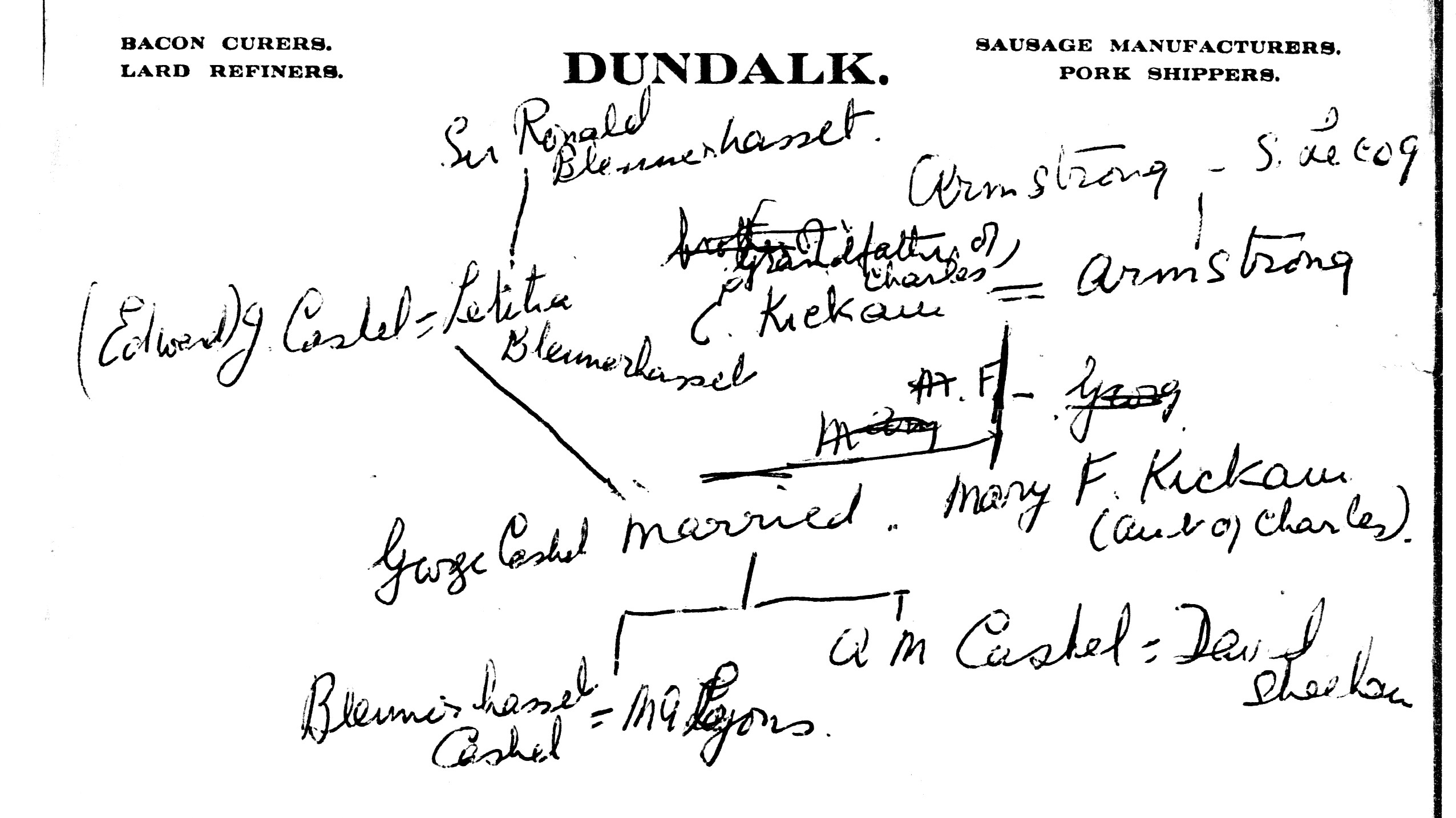
Pat incorporates the idea that Letitia is the daughter of Sir Rowland
(incorrectly written "Sir Ronald").
From
[PAT/13, no.1]
Pat incorporates the idea that Letitia is the daughter of Sir Rowland into her notes.
From
[PAT/10, p.3].
See full size.
This combines
the family story of a romantic runaway marriage
with the idea (either part of the original family story or maybe a newer idea)
that Letitia is the daughter of Sir Rowland.
For years, I thought the connection to Sir Rowland was made up.
Now I think it is basically true!
Though some details may be wrong.
In her notes,
Pat Lavelle
remembers her aunt
Alice Cashel
and
Jim Sullivan
arguing
over whose family had a claim to the
Blennerhassett estate.
Date apparently before 1921:
Jim Sullivan left Ireland in 1921.
If it is true that he never returned to Ireland to visit, this argument must be before 1921.
He died in America in 1935,
so the argument is certainly before 1935.
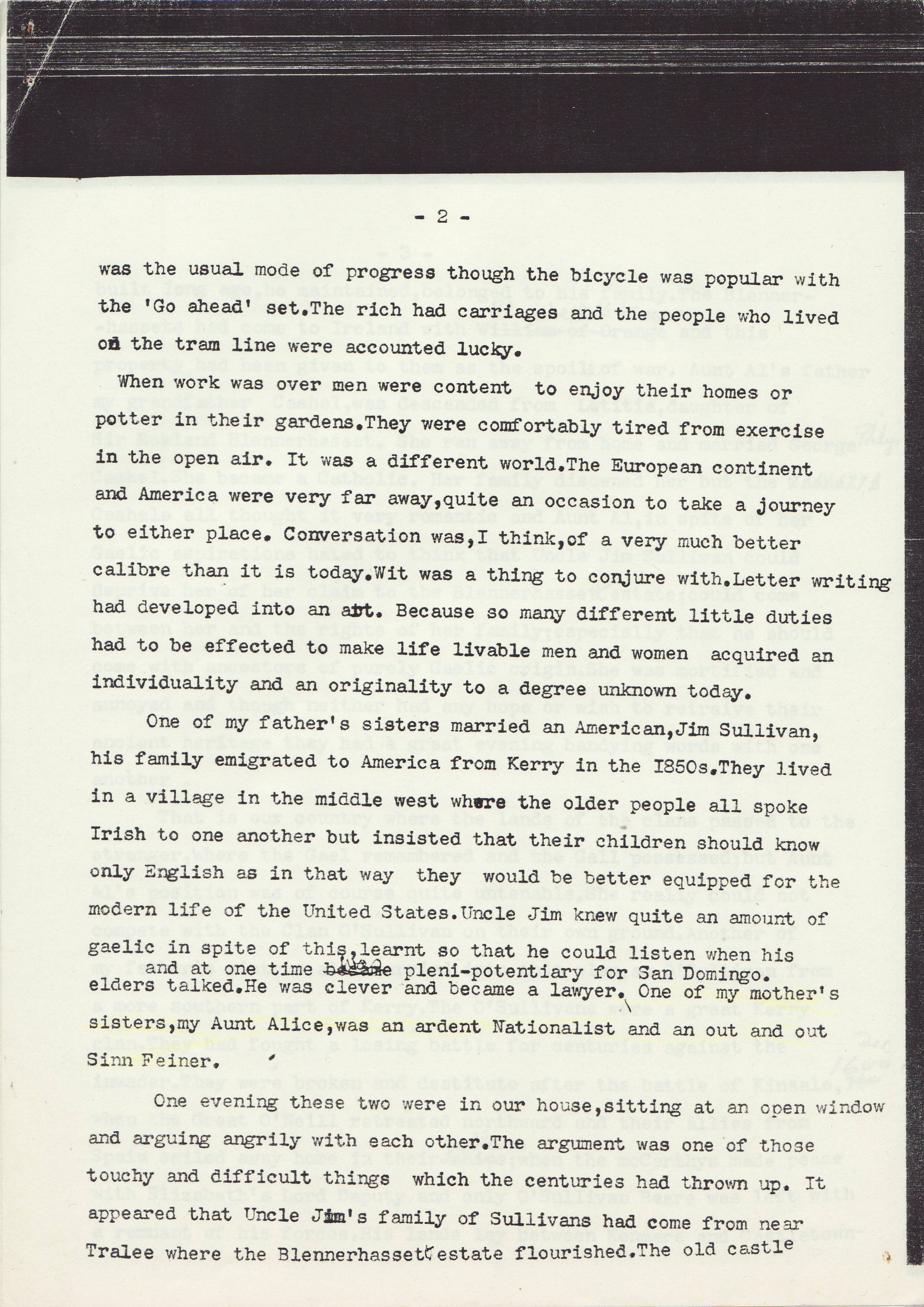
Pat said that Jim's Sullivan family
"had come from near Tralee where the Blennerhassett estate flourished.
The old castle built long ago, he maintained, belonged to his family."
(He would mean the old Irish
Clan O'Sullivan.)
And
Alice had her Blennerhassett ancestors.
(One would love to hear what evidence she presented!)
So Jim and Alice argued about who had a claim to the old estate.
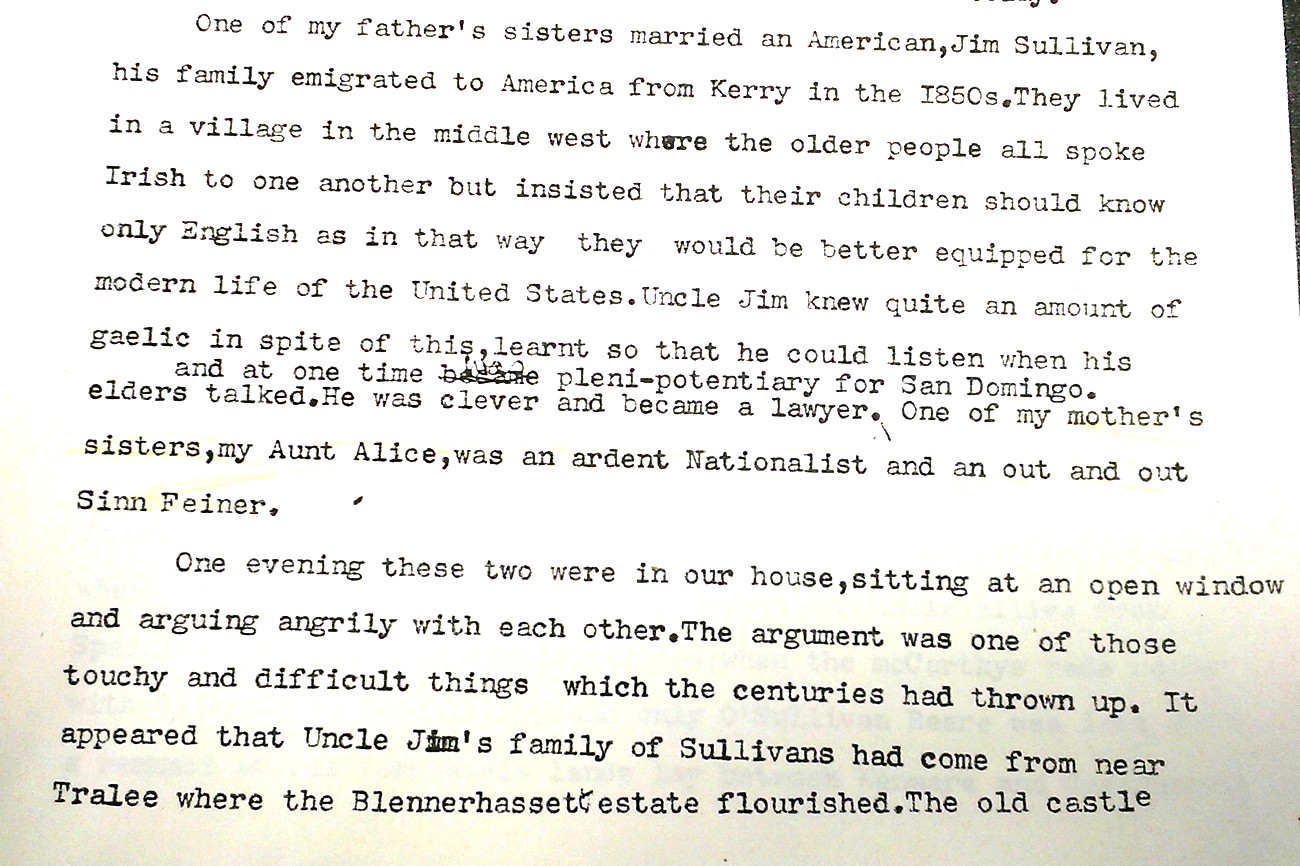
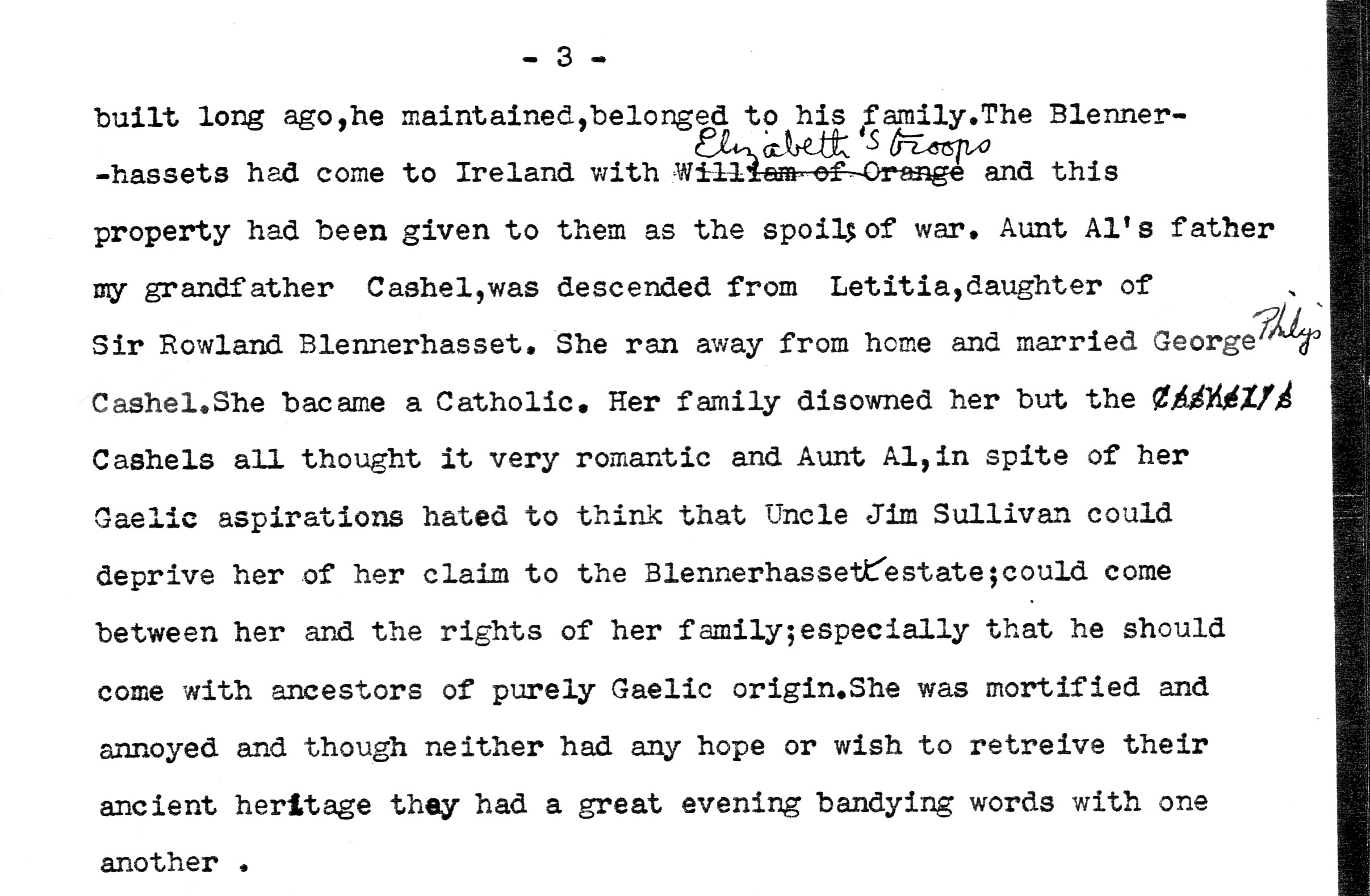
The Alice Cashel argument with Jim Sullivan.
From
[PAT/10, p.2 and p.3].
See full size
p.2 and
p.3.
I took decades to realise the argument is about Churchtown
The addition of "Tralee" meant I took decades to realise
the argument is about
Churchtown near Killarney,
and hence about the Blennerhassett Baronets branch.
- I knew
Jim Sullivan's family
were from the Killarney area, not the Tralee area.
But only after a few decades, when I researched the Sullivan origin,
did I see exactly where in the Killarney area
they were from.
- They were from Dromaloughane, in which townland is the ruined Castle Corr,
built by McGillycuddy,
said to be
a branch of the O'Sullivans.
The castle was built c.1450.
- In the next townland is
the 18th century Blennerhassett house,
Churchtown House.
Blennerhassett had acquired the McGillycuddy (O'Sullivan) estate.
- Churchtown House was the seat of the Blennerhassett Baronets branch.
(They also had a house at Blennerville, near Tralee.)
- So it all makes sense, if we get rid of "Tralee".
And it is more evidence pointing towards the Blennerhassett Baronets branch.
- Why did Pat mention Tralee?
Because Tralee is the main place Blennerhassett are associated with.
There is an entire village, "Blennerville", near Tralee.
Blennerville House, near Tralee,
was the other seat of the Baronets family, besides Churchtown House.
The biggest Blennerhassett house is
Ballyseedy
near Tralee.
It is perfectly normal for Pat to think they were referring to Tralee,
when trying to remember this years later.
- Ballyseedy was also the estate of an old Irish castle.
However it was not a castle of
Clan O'Sullivan,
but rather a
Desmond castle.
Did Alice Cashel know about Churchtown?
So Jim Sullivan was right.
And DNA (see later) says Alice Cashel was right.
Her Blennerhassetts were from Churchtown. And she probably knew that.
But that information was not transmitted to
Pat Lavelle.
I had to go and dig it up again, a century after this argument took place.
A link to Churchtown
means our family are linked to
Sir Rowland Blennerhassett, 1st Baronet,
who built it.
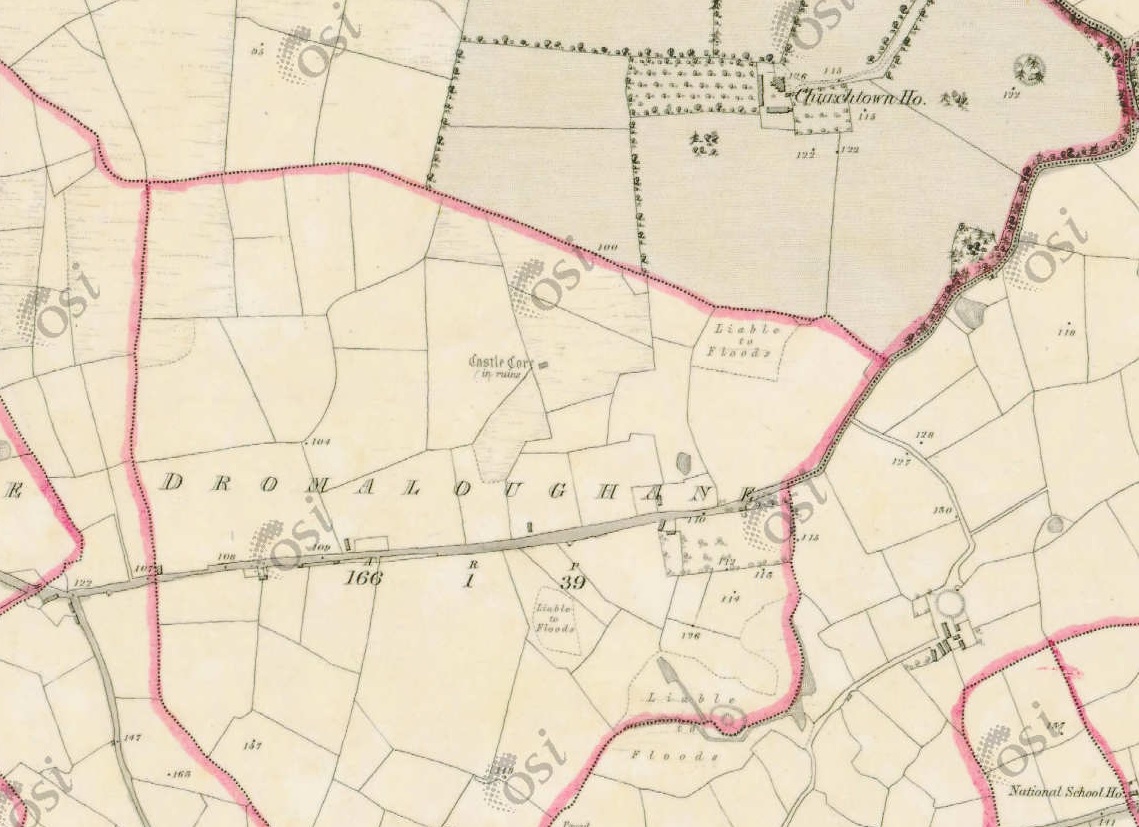 Jim Sullivan
came from
Dromaloughane, near Killarney, Co.Kerry.
In Dromaloughane townland is the ruin of
Castle Corr.
Above it in Churchtown townland is the Blennerhassett house,
Churchtown House.
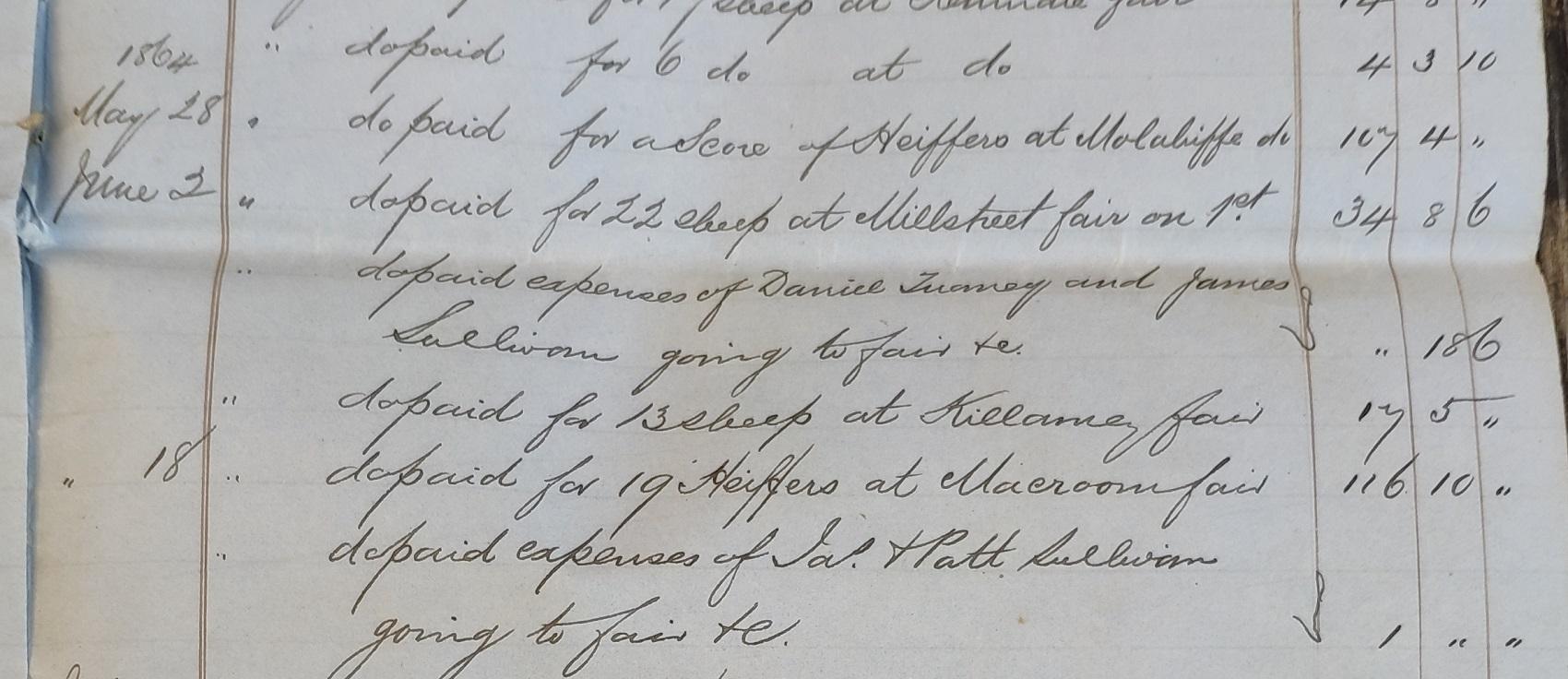
Expenses for
"James Sullivan" in payments made in
June 1864 by
Sir Rowland Blennerhassett, 4th Baronet
of Churchtown House.
From
Churchtown House accounts book 1862-64.
This could be Jim Sullivan's father.
Above is what we knew in the 1980s.
Now we discuss how we managed to move this story forward.
We start with the name
"Letitia Blennerhassett".
I laid out the page above
to make the Baronets line look the most promising lead.
But it did not look the most promising lead for many years.
The name "Letitia Blennerhassett" seemed by far the best lead.
What a rare name. It must be telling us something.
I got nowhere with
Letitia Blennerhassett of Co.Limerick.
But when I looked deeply (starting in 2009) into the life of
Letitia Blennerhassett of Tarbert,
I found a lot of circumstantial evidence that something happened in her life around 1806.
That maybe she had an affair and separated from her husband
and could be the mother of George Cashel.
I found a lot of exciting-looking clues that something like this may have happened.
- So I constructed a theory from the paper evidence that our ancestor might be
Letitia Blennerhassett of Tarbert.
The paper evidence looked really good.
-
See
Theory of our descent from Letitia Blennerhassett of Tarbert.
- After years of looking at paper evidence,
I started a DNA project to test our family and Letitia's family.
-
To my surprise, the DNA said that the theory is not true.
- See DNA testing - Cashel with Letitia Blennerhassett of Tarbert.
- This DNA failure seemed like a disaster.
But one good thing is that when we finally got good DNA matches, with a different Blennerhassett branch,
this failure shows why our new matches really
are proof.
The Letitia theory is false
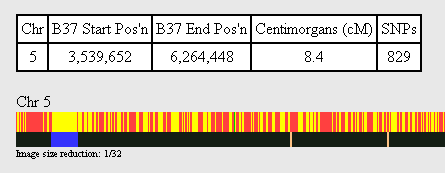
By 2020, I had done
hundreds of one-to-one DNA comparisons
of Cashel people with Letitia people.
And I had never got a match better than
8.4 centimorgans (cM).
Comparing my results with
what hits are like for real cousins
showed I should have already found a load of great, strong hits.
But I got nothing.
At this point (in 2020)
I decided I had proved the Letitia theory is false.
Later, after hundreds more comparisons,
I got up to a 10.7 cM match of my family and some rather distant relations of Letitia of Tarbert.
But I still say the Letitia theory is false:
- The matches are still far too weak.
- The matches are in the wrong place.
Not at the postulated 4th cousins, not near Letitia of Tarbert herself,
but rather at distant relations of Letitia.
- All the high matches are
in the Griffin family,
which has various Catholic Kerry ancestors.
Probably the matches are not through their Blennerhassett line at all,
but through some other Kerry line.
The failure of the Letitia theory
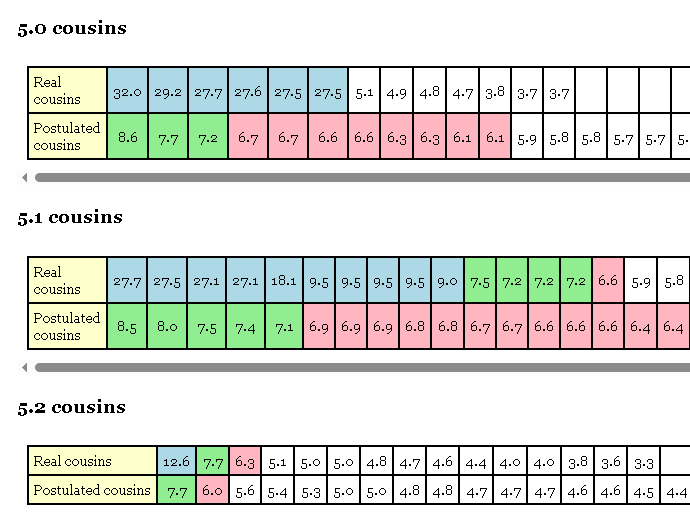
The three groups are 5th cousins, 5th cousins once removed, and 5th cousins twice removed.
For each of the groups, the top row shows
what DNA matches look like for real (known) cousins.
The bottom row shows
DNA matches for the postulated cousins under the Letitia theory.
There should be some nice strong (blue) matches among the postulated cousins. But there are not.
Conclusion:
They are not 5th cousins.
The Letitia theory is false.
See details.
The success of the Baronets theory
For comparison, we preview what a working theory looks like:
the Baronets theory, which will be explained later.
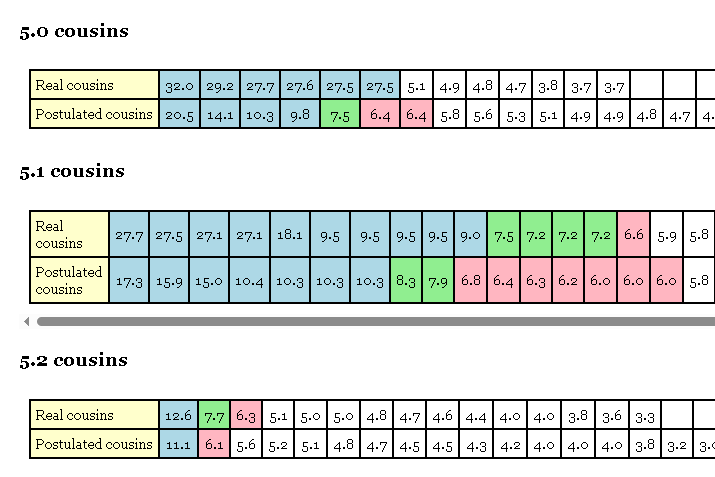
Top row:
What DNA matches look like for real 5th cousins.
Bottom row:
DNA matches for the postulated 5th cousins under the Baronets theory.
Conclusion:
They are really 5th cousins, or 6th cousins.
The Baronets theory is true.
See
details.
After abandoning the Letitia theory, we turned to a "Plan B".
From the above scraps of evidence,
the obvious "Plan B" is the
Blennerhassett Baronets branch.
So I started a project to DNA test our family and the Baronets family.
And immediately, on the very first sample, DNA proved the two families are fairly closely related. The Baronets theory is true.
I have now found multiple strong DNA matches
of our family
with the Blennerhassett Baronets family
and, crucially, with the Yielding family who are doubly intermarried
with the Blennerhassett Baronets family.
There is no doubt that our family is closely related to both families,
and indeed, must descend somehow from the original couple,
Robert Blennerhassett and Frances Yielding.
For full proof of this, see Proof of descent from Blennerhassett Baronets family.
After proving some DNA link to the Blennerhassett Baronets family,
I went searching for the largest cluster of
unexplained DNA matches
across the George Cashel family.
When I found it, I discovered to my surprise it is the
O'Connell family of Co.Kerry,
in particular the branch
closely related to
Mary O'Connell who married Daniel O'Connell.
This family knew the Blennerhassett Baronets family socially,
and were
related to them by blood and marriage.
We now have multiple strong DNA matches to this family,
indicating a fairly recent branching off of George Cashel from this family.
The most obvious interpretation
is that the mother of George Cashel is from this family
and his father is from the Blennerhassett Baronets family.
To be precise, the DNA would be explained if George Cashel's mother
was a sister of Mary O'Connell.
But we must keep an open mind.
There could be some other, less obvious, connection to O'Connell.
I used to think the wealthy Blennerhassett man probably had an affair
with a lower status female.
But I am now thinking, incredibly, that she was a woman of his own class.
If so, surely this problem can now be solved.
This whole strand of evidence has been open since 2025 and remains to be tied in with the other strands.
It is interesting that my family remembered Blennerhassett, but not the much more famous
Daniel O'Connell.
But maybe because George was a Blennerhassett by descent,
while Daniel O'Connell's relationship is less direct. (He married a close relation.)
Summary tree of O'Connell matches
      Thomas O'Connell = Ellen Tuohy
                       |
   +-------------------+---------------+
   |                                   |
  Mary O'Connell                      Elizabeth O'Connell
  m. Daniel O'Connell                 m. James O'Connor (or James Connor)
   |                                   |
   |                                   |
  DNA MATCH                           DNA MATCH
  29 cM                               29 cM
As I developed the O'Connell theory in 2025-2026,
I considered that
neither parent of George Cashel might be Cashel.
So how can he be called Cashel?
Well one reason would be if he was an unwanted natural child who was
adopted.
So
I started looking again at a George Cashel, baptised in July 1808, son of Stephen Cashel, that I had known about for many years.
Now I looked at him with new eyes, wondering if this could be our George and
he was adopted by the Stephen Cashel family.
Evidence of descent from Stephen Cashel family
shows the considerable amount of evidence and clues that our George Cashel
may be the same as the George Cashel in this family.
Many things make sense if we descend from this family.
Whether he is their biological child or adopted child we do not know.
Nor have we proved this is our George.
The date of baptism of their George (July 1808) indicates the date of the affair would be late 1807.
However, what if George Cashel is not the irregular child?
What if he just descends from the irregular child?
Because the Stephen Cashel family
descends from a Catherine Blennerhassett, born around 1760,
and she may in fact be our descent from the Baronets family.
If she is the irregular child, then the affair is around 1760.
An adoption was always a bit of a clunky theory, bringing in three families to explain things.
If Catherine is the natural child, then we only have two families, and George descends from one of them.
The Stephen Cashel line of research is simply adding to the mountain of clues,
without being able to put them all together into a final proof.
We will continue to work on this Stephen Cashel family and see what happens.
We will now consider various issues, before summing up what we know.

Extract from
[Deed of 1843].
Shows Catherine Blennerhassett
is mother of Agnes Noonan
and grandmother of George Cashel.
In May 2020, I found DNA evidence that our family is closely related to
the 1st Baronet.
The family history suggested our ancestor was
a
daughter of the 1st Baronet.
And now DNA was confirming something like this.
However, no daughter was found in the official histories, such as Burke's Peerage.
I had looked for a daughter before, and not found one.
Bill Jehan had not found one.
On 13 June 2020, this changed.
I discovered that the 1st Baronet did have a daughter,
Melisent Blennerhassett,
baptised in Dublin in Jan 1768,
who is not in the official family histories.
This was exciting.
The evidence made a prediction
that a daughter might exist.
And a daughter was found.
Maybe she ran away and was written out of the family history?
However it was a false alarm.
On 16 June 2022, I discovered that Melisent died as an infant and was buried in Dublin in May 1768.
We note there is an unidentified "Letitia Cashel" in 1837.
With such a rare name combination, could she be connected to our family?
So far, we have found out almost nothing about her life.
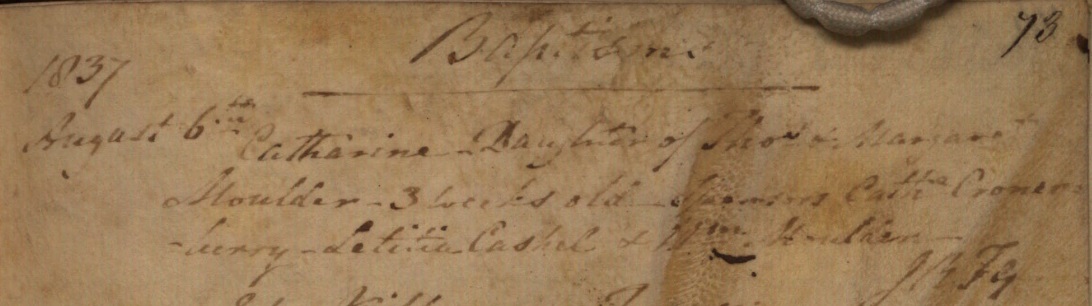
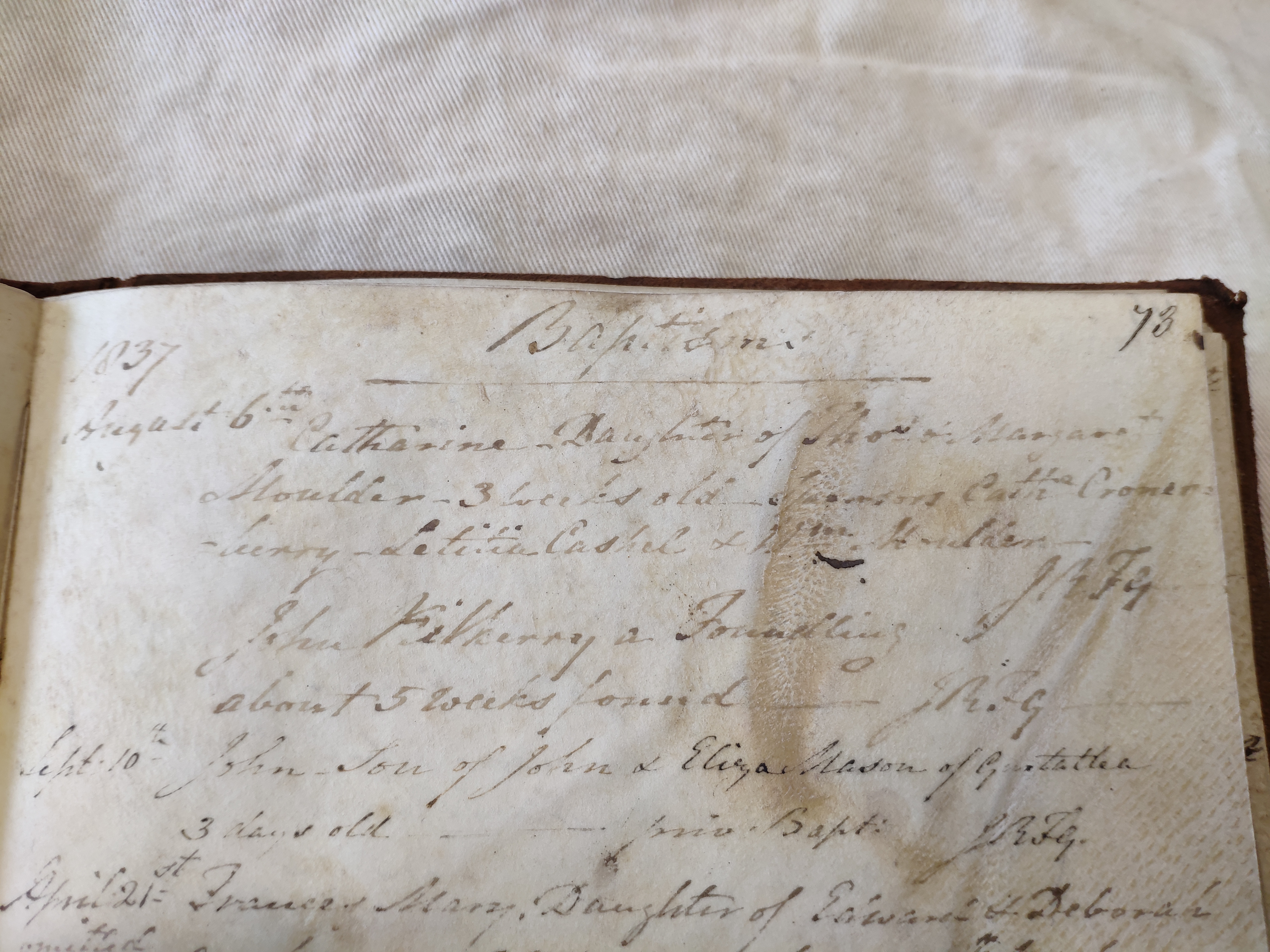
"Letitia Cashel"
sponsored the CoI baptism of Catherine Moulder
on
6 August 1837
at Ballymacelligott, E side of Tralee.
Don't know if maiden name or married name.
From
[Ballymacelligott and Ballyseedy CoI par records].
See
other photo.
There is also a Letitia Yielding,
from the Yielding family that our family is DNA related to.
- DNA says we descend from Yielding.
- There is a Letitia Yielding (born 1777, died 1844).
She apparently lived in Tralee parish
and was buried in Ballymacelligott parish.
-
Could she be Letitia Cashel?
She runs away with Cashel and is mother of George Cashel?
She uses the surname Cashel but (this is the unlikely bit)
reverts back to Yielding later.
- Probably not.
Letitia Yielding is written as "Letitia Yielding, spinster"
in a court case in 1811.
- See
Yielding theory
for more
on whether Letitia Yielding could be our ancestor.
We have got nowhere with the name
"Letitia".
It could be an error.
It is noted that none of the Cashels were given the name "Letitia".
If there is a female name in the Cashel family, it is "Agnes".
-
George Cashel named his eldest daughter
Agnes Cashel
in 1838.
- She died and he named his next daughter
Agnes Cashel
in 1842.
She is also written as "Agnes Mary" or "Mary Agnes".
His wife was Mary.
- The name "Agnes" was clearly important to George. Maybe his mother or stepmother.
- "Agnes" became a name in the Cashel family.
- People in our family called Agnes, which may have come from Blennerhassett:
- Blennerhassett Cashel marries Maria Agnes Lyons, so we cannot really say Agnes comes from Blennerhassett in his descendants:
- Millicent Agnes Yielding in the Baronets family:
- The 1st Baronet's wife was
Millicent Agnes Yielding.
Her mother was Millicent.
-
Many descendants of the 1st Baronet and Millicent Agnes Yielding
used the name "Millicent Agnes" or "Melicent Agnes" after her.
- Could George Cashel have used Agnes after Millicent Agnes Yielding?
- Agnes Denny:
- Most likely theory: Agnes Noonan.
- Currently the most likely theory is that
Agnes Noonan
is mother of George Cashel (either natural or adopted mother)
and hence the name for his daughter.
We do not know of the existence of any
"Letitia Blennerhassett"
who could be our ancestor.
Maybe it is an error.
But
how could the family mis-remember such a rare name?
Here is one way.
- If George Cashel's family are closely related to the 1st Baronet,
then they are closely related to
Rowland Blennerhassett of Kells,
whose wife is Mrs. Letitia Blennerhassett
(born Letitia Hurly, married 1808, alive in 1822, died before 1834).
- I do not think Letitia Hurly could be mother of George Cashel.
I do not think she could have had a natural child before marrying Rowland. Reasons:
- His father would never have allowed the marriage.
- The marriage settlement mentions no child.
- The DNA connects us to Blennerhassett. That would make no sense if Blennerhassett was not related.
-
I do not think Letitia Hurly is the mother.
I think she is some close relation.
So how was she remembered?
- One way she could be remembered
would be if she wrote letters.
The name "Letitia Blennerhassett" might have been remembered from the letters,
and the name accidentally transferred to the mother
when the great-grandchildren were trying to remember the story in the 20th century.
- Or, and perhaps most likely of all,
the name was remembered just because of the
stained glass window in Tralee.
The remembered name "Letitia Blennerhassett",
and the
possibly remembered name "Rowland Blennerhassett",
may both come entirely from the stained glass window
in Tralee church.
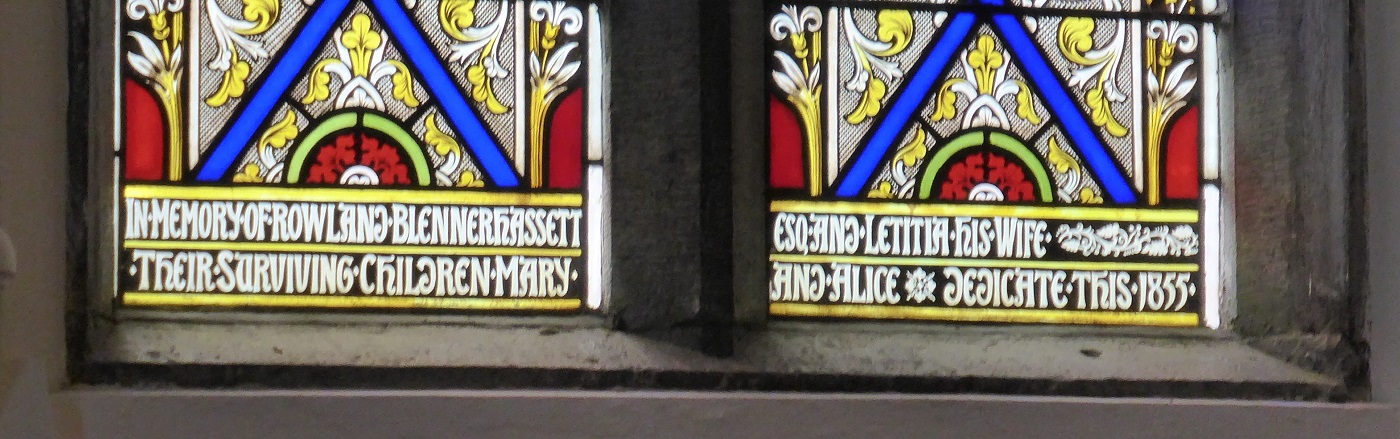
Stained glass window to
Mrs. Letitia Blennerhassett (Letitia Hurly).
In
St.John's CoI church, Tralee.
-
This window may be the answer as to where "Letitia" came from.
-
It is one of the most visible Blennerhassett monuments in Tralee.
-
It is possible, even likely, that
Blennerhassett Cashel
showed this window to his children
when on visits to
his Falvey in-laws in Tralee
before 1904,
and told his children (correctly) that these Blennerhassetts were close relations,
and this reinforced in later memory
that their ancestor was "Letitia".
-
This window may in fact be the whole origin of the name "Letitia".
- It was easy for Blennerhassett Cashel to get to Tralee since
his employer the GSWR had a line to there since 1859.
(GSWR had a line to Killarney since 1853.)
- So was "Letitia" a false clue?
- Not at all.
If Blennerhassett Cashel showed the window to his children,
then he probably knew he was the Baronets branch.
-
The name "Letitia" may in fact be evidence for the Baronets branch:
Looked at this new way, the name "Letitia" is evidence for the Baronets branch,
since it indicates they looked at this window and considered it their branch.
Pat Lavelle's papers
were a treasure trove for the broader family tree.
However, for the Blennerhassett hunt,
it would perhaps have been better if I never found her notes!
If I never found her Blennerhassett notes:
- I would never have had the name "Letitia".
- I would never have wasted a decade on Letitia of Tarbert.
- I would never have spent time on Letitia of Co.Limerick either.
- I would not have the account of the Sullivan argument, which pointed to Churchtown.
- I would not have the vague clues pointing to the Rowland and Letitia window.
Instead I would have the following:
- We somehow descend from Blennerhassett. (Obvious from the names.)
- George Cashel, policeman, is recommended by A. Blennerhassett.
- This must mean we are related to either the Baronets branch or the Ballyseedy branch.
- So my DNA hunt would have focused on those two branches.
- DNA would soon find it was the Baronets branch.
So I would have ended up at the same place, without such a massive detour.
There were some good things about finding her notes:
- Without them, I would lose: (1) the account of the Sullivan argument,
and: (2) the clues pointing to the window,
both of which are thin documentary clues backing up the Baronets branch.
It is nice to have them.
-
It is also nice that at least one person noticed the Blennerhassett descent before me, and tried to work it out.
It was not just something I discovered on my own.
But Pat's notes ultimately led to a decade of wasted work,
to arrive at the same place I would have arrived at without them.
So overall
it would probably have been better if I never found Pat's papers in the 1980s!
Through the almost impenetrable wall of
over
200 years of silence,
the clues in the family stories were finally supported
by the DNA, which says something in the stories is true.
Somehow DNA from the Blennerhassett Baronets family was transmitted forward and made George Cashel.
Something like the following.
An affair.
A natural child written out of the family history.
An unapproved marriage.
A Blennerhassett daughter disowned and maybe soon dead.
A seduction of a Blennerhassett daughter
by a man who ran, or
a man who was already married.
A Blennerhassett son, having an affair with a local woman or a servant,
barely noticed outside the family,
and a child that took her name not his.
Something happened.
The DNA says it happened.
Part of the family story is true.
There was no long descent of a chain of Blennerhassetts from some unknown origin.
This was a short and sudden descent from one of the glamorous, high-profile branches of the Blennerhassetts.
Conclusion so far
The conclusion so far is that we have proved some connection to the Baronets line,
and we have an increasing body of evidence about what happened.
We have one line of evidence about the Baronets branch:
We have two more lines of evidence:
- DNA evidence has emerged that we are closely related to the
O'Connell family,
who knew the Blennerhassett Baronets and were related to them.
This family is
closely related to
Mary O'Connell who married Daniel O'Connell.
George Cashel's descendants have strong DNA matches to this family,
which suggests he branches off late from this family.
The simplest theory would be that his mother is from this O'Connell family,
and his father is from the Blennerhassett Baronets family.
- Documentary evidence has emerged that we may descend from the
Stephen Cashel family,
through either a natural or adopted child.
Many things make sense if we descend from this family.
This family descends from a Catherine Blennerhassett, born around 1760,
and she may in fact be our descent from the Baronets family.
An alternative theory is she is not relevant but her daughter adopted George Cashel.
We have a mountain of clues but no narrative to unite them.
We are very close to putting together these three pieces.
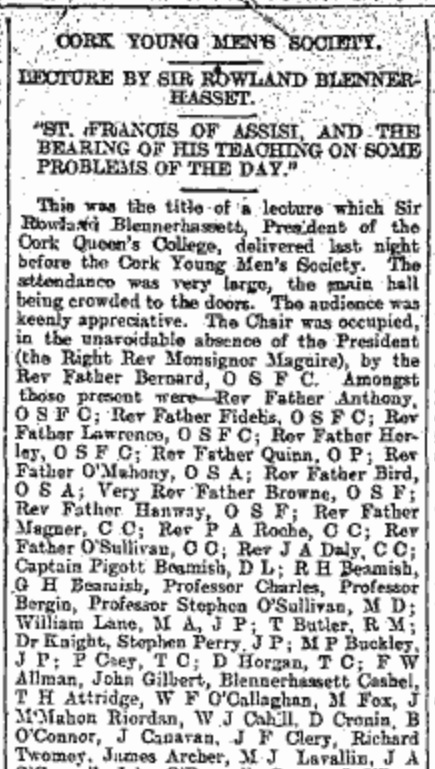
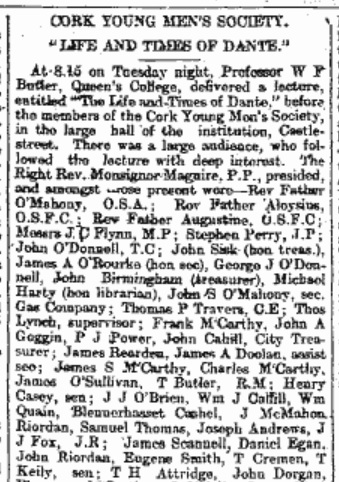
My ancestor
Blennerhassett Cashel
attends a lecture in 1899
in Cork by
Sir Rowland Blennerhassett, 4th Baronet.
From Cork Examiner,
March 29, 1899.
Blennerhassett Cashel was GSWR goods head at Cork, apparently 1893 to 1911.
The 4th Baronet was Catholic, succ 1849, President of Queens College Cork 1897-1904.
-
Blennerhassett Cashel being at this talk
is not really evidence of a relationship, since the 4th Baronet was a well-known figure in public life,
Catholic, and the President of the College in the city where
Cashel lived.
Cashel used to go to these type of talks anyway.
-
See
Cashel at a similar lecture the year before,
reported in
Cork Examiner,
March 17, 1898.
-
But it is interesting that the only Blennerhassett I can find on the same page as my family
is from the Baronets branch.
-
According to the theory above
they are cousins.
They could even be 1st cousins, if the 2nd Baronet is the natural father of George Cashel.
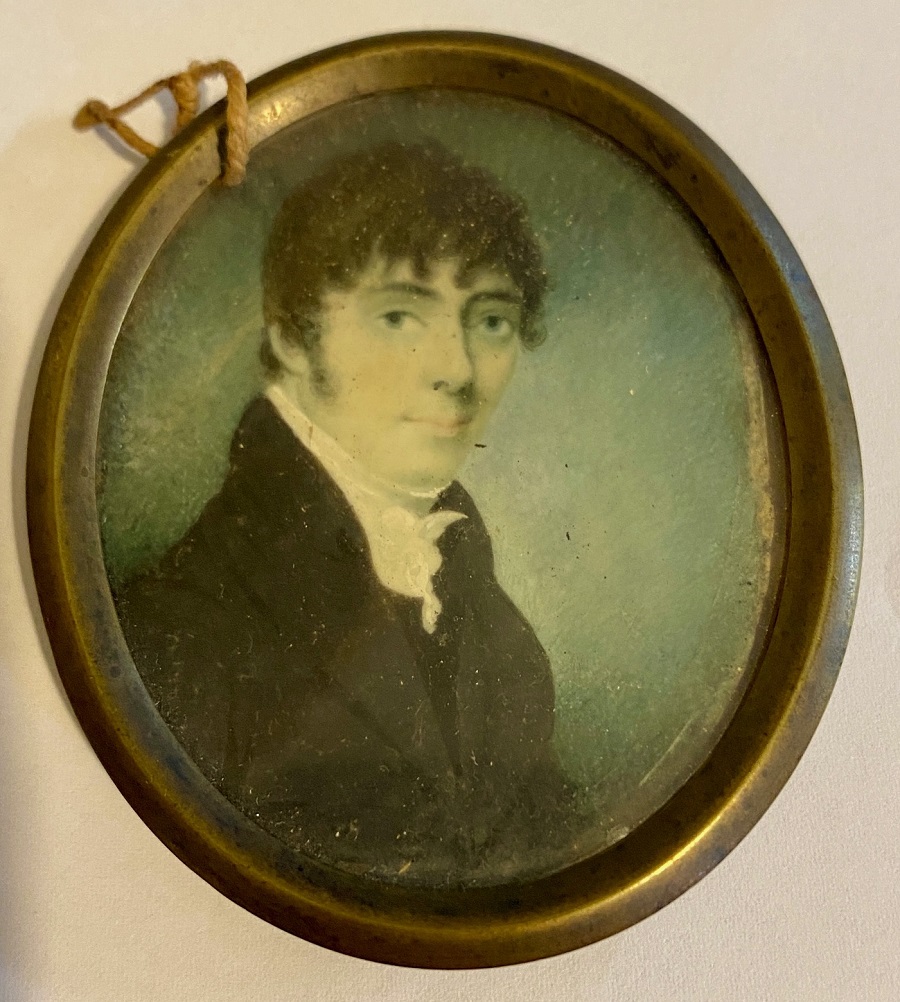 Rowland Blennerhassett, of Kells
.
Could he be the father of George Cashel?
"We entered Tralee about seven o clock ...
This is the county town of Kerry and is by far the most considerable town in the county
and spoke of as the wickedest town in Ireland
for everything that is bad and obscene."
- An anonymous traveller in Kerry in 1788,
possibly indicating the kind of social environment that produced George Cashel.
From "Journal of a Visit to Kerry in July 1788",
Gerard J. Lyne,
Journal of the KAHS,
No.21, 1988, pp.133-139.
Donation Drive
Please donate to support this site.
I have spent a great deal of time and money on this research.
Research involves travel and many expenses.
Some research "things to do"
are not done for years, because I do not have the money to do them.
Please Donate Here
to support the ongoing research and
to keep this website free.